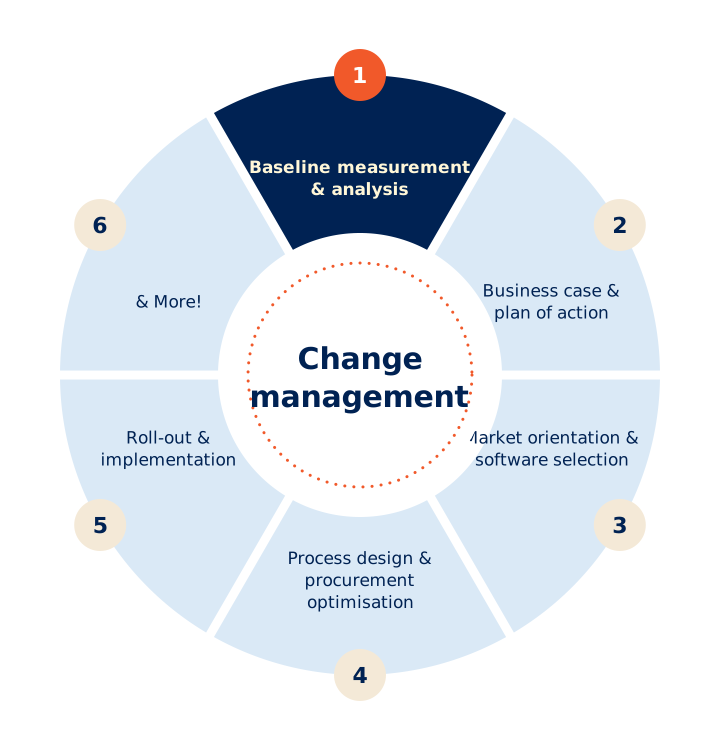
A new S2P process only succeeds if people use it. For us, change management is not a work package that starts after the build. It is at the heart of our approach and delivers specific results in every phase.
Source-to-Pay affects almost everyone in your organization. The requester on the shop floor, the budget holder approving requests, accounts payable, procurement, IT, and your suppliers: every group will be doing things differently. Change management ensures that this actually happens. For us, change management is not a separate track alongside the implementation. It runs through every phase, from the baseline measurement to long after go-live. Because the requester who still sends an email to the supplier after the system goes live rarely has a knowledge problem. Usually, the old way is simply easier.
What’s in it for you?
An S2P implementation is a significant investment. Your business case relies on savings, less manual work, and better spend control. Those returns only materialize when the new process is actually used.
Your business case will deliver results. Savings don't come from the system, but from orders that flow through the system.
The post-go-live dip is avoided. Without reinforcement, employees fall back into old habits. With reinforcement, the PO percentage continues to rise.
Your organization stands on its own two feet. Your own team manages, improves, and defends the new way of working, even after we have left.
You can recognize good change management by…
a diagnosis before the solution. First, you find out who is taking the detour and why. Only then do you choose between process adjustment, communication, or training.
a new route that is the easiest one. Fewer clicks, good default settings, populated catalogs. If the detour is faster, the detour wins.
colleagues who take the lead. Key users and a sounding board group with real influence. People follow colleagues, not the project team.
data instead of a gut feeling. The PO percentage per department shows where the change is taking hold and where it isn't.
focus after go-live. Going live is a milestone, not the finish line.
For us, change management is not a work package that starts after the build. It is at the heart of our approach and delivers specific results in every phase.
How we work: from goal to behavior
Our approach is practical, measurable, and focused on what people will do differently tomorrow.
Vier onderdelen van onze aanpak voor adoptie van een Source-to-Pay proces
Onderdeel
Zo pakken we het aan
1. Een scherp doel
Adoptie begint bij meetbare afspraken. Welk deel van de inkoop loopt straks via een order? Hoeveel via de catalogus? We leggen het vooraf vast, per afdeling.
2. Concreet gedrag
Wat doet de besteller, de budgethouder of de crediteurenadministratie morgen anders, en waarom gebeurt dat nu nog niet? Stokkende adoptie is zelden een kennisprobleem. Daarom zoeken we eerst uit waar het misgaat: in het proces, in de rolverdeling of in het draagvlak.
3. Support die het makkelijk maakt
Het makkelijkste pad wint, altijd. Kost bestellen via de portal meer klikken dan een mailtje, dan verliezen we van dat mailtje. Dus ontwerpen we de omweg weg: kortere formulieren, slimme catalogi, goede defaults en heldere werkinstructies. En we zetten key users en een klankbordgroep in, want collega’s volgen collega’s, niet het projectteam.
4. Meten en vasthouden
Een tevredenheidsenquête zegt niets over gedrag, het PO-percentage wel. We beloven geen getal vooraf, wel dat er een getal komt. We blijven meten na de go-live en sturen bij waar een afdeling achterblijft.
The proof: Dichterbij
At healthcare organization Dichterbij (over 2,800 FTE, more than 940 locations), we started with a baseline measurement, a project team from IT, Finance, and Procurement, and a sounding board group of users. We then took on a coaching role. An internal control plan and periodic meetings with the chain manager kept the process on track. A year after go-live, the number of POs was higher than at the time of the launch. The usual dip never happened.
We remove the detours the organization is currently taking. For each group , requesters, budget holders, accounts payable, or procurement - we map out what is changing and what is holding them back. We then make the new route the easiest one and deploy key users to bring their colleagues along.
Is adoption lagging, or is an implementation on the horizon?
Get in touch with our change management experts, Derek Hooyman or Thomas Bennis. They are happy to brainstorm with you, independently of any software vendors. One conversation is all it takes to identify where the bottleneck lies.