.jpg)

A good Source-to-Pay business case is convincing. A strong business case helps you choose. And that's why scenarios are indispensable. By developing various solution directions, you give management concrete choices — including the impact, risks and rewards per option.
In this blog, you'll read:
- Why scenarios are essential in your business case
- Which scenarios are often developed in S2P processes
- And how to present them honestly, substantiated and convincing
👉 Are you working on a business case for S2P optimization?
Why include scenarios in your business case?
A business case is not a sales story, but a decision-making document. By developing multiple scenarios:
- Increase support: stakeholders feel taken seriously
- Limit your discussion afterwards: choices have been made explicitly
- Substantiate your direction: you show that the chosen route has been considered
- Make your impact concrete: what is changing — and what isn't?
This is how your business case transforms from a plan into a professional decision tool.
📊 Common scenarios in S2P optimization
Depending on your current situation and ambition, you will work out multiple scenarios. Here are the most common scenarios:
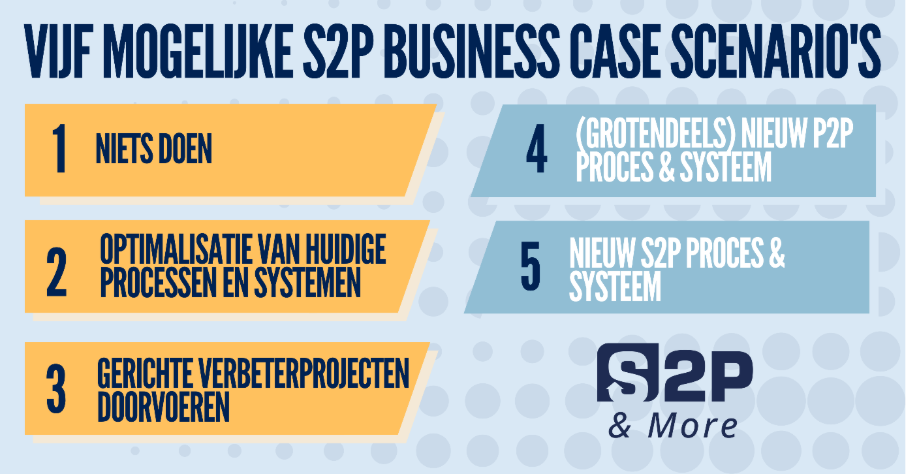
1. Do nothing
Maintain the current situation. This sounds passive, but it is a conscious choice. Because time that you don't put into this process can be spent elsewhere. Be sure to mention the risks:
- Inefficient processes
- Fragmented data
- Operational costs that continue to rise
- Limited insight into spend and compliance risks
2. Optimization of current processes and systems
Minor adjustments to existing processes and systems. This allows you to really address your pain points and you can make quick strides in optimization. Think about:
- Process redesign
- Automation strokes
- Better reports
The advantages: low investment, fast results.
The disadvantages: depending on your current system, this is not future-proof and has little structural impact.
3. Carrying out targeted improvement projects
In this scenario, you tackle small-scale and targeted improvement projects, where you try to achieve a major effect with relatively little effort, without changing the foundation of your existing processes and systems. Think about:
- Make new agreements with the top 10 largest suppliers about processing e-invoices
- Connect 5 new web shops because it gives you significantly more POs
- Mapping CO2 emissions with the top 5 suppliers
- Start of communication and training campaign to stimulate the use of the S2P process
4. A completely new Purchase-to-Pay process and system that includes purchasing and invoice processing brings together.
Benefits:
- Modern technology
- Efficiency across the chain
- More control and transparency
This scenario focuses on the operational chain between order and payment, but often does not touch the strategic purchasing or contract phase.
This investment is high, so this business case is often relevant when your current solution is not future-proof.
5. New S2P process and system
A forward-looking total solution that supports the entire Source-to-Pay process — from sourcing and contract management to ordering, billing and payment.
Benefits:
- One integrated platform for purchasing, contract, order and payment
- Full insight into supplier performance and expenditures
- Supporting strategic decision making and operational efficiency
- More control over compliance, sustainability and risk management
This scenario requires the most change and investment, but also offers the greatest long-term potential.
The Source-to-Pay market is developing rapidly. More and more innovative providers are entering the market with powerful solutions that add both strategic and operational value. So it pays to explore the options carefully — the right choice can help your organization move forward structurally.
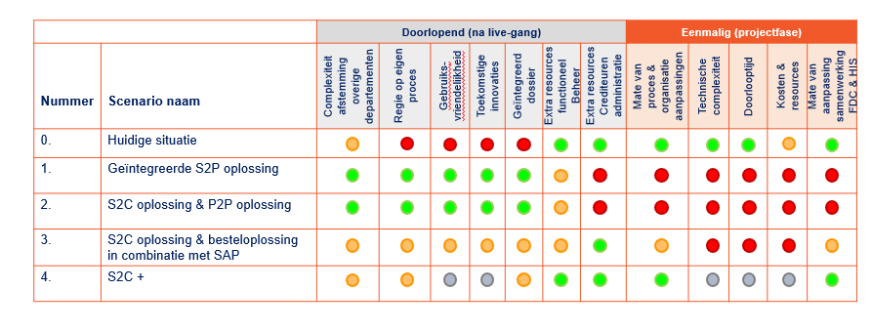
️ How do you compare scenarios?
Work out each scenario based on two dimensions:
During the project:
- Investment (time, money, capacity)
- Change impact and necessary guidance
- Implementation risks
After going live:
- Future-proofing
- Functional coverage and scalability
- Maintenance and Management
- Value creation (savings, insight, control)
Preferably use a summary table or scorecard to visualize this by scenario.
💡 Tip: Be honest and transparent
Management doesn't want a 'bought' proposal — they want choices that are understandable, substantiated and realistic. So be transparent:
- Also mention the limitations of your preferred option
- Show that you've taken a serious look at the alternatives
- And be open about risks and dependencies
This increases your credibility and speeds up decision-making.


.jpg)